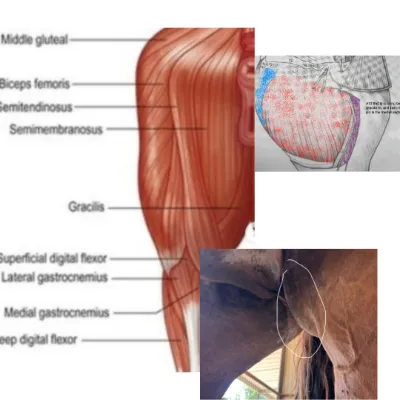
Equine Gracilis/Groin Muscle

The Horse Groin Muscle Nobody Talks About (But Your Horse Will Thank You)
During a recent session with Spoon, something unexpected happened. As I was working on his stifle area (to his tolerance), I found myself exploring a specific area—just behind and slightly underneath the scrotum, running along the inside of the hind legs. It seems this region, often overlooked in traditional massage training, includes the gracilis and adductor muscle group—and Spoon absolutely loved having it worked on.
Quick note: This is a highly sensitive area, so if you try this, go slow and gentle.
His response ignited my curiosity about why this muscle group might be so reactive, especially in performance horses like Spoon, who works as a cutter—a discipline that involves quick turns, rollbacks, pivots, and collected circles.
Here’s what I’ve learned:
🐴 Groin Area in the Horse

In equine anatomy, the "groin" refers to the medial (inner) thigh—the area between the hind leg and the body wall, just behind the sheath or udder. Several key muscles reside here:
Gracilis
Adductor
Pectineus
Sartorius
These muscles help stabilize the pelvis, draw the leg inward (adduction), and contribute to propulsion and stride quality.
The gracilis (which is the muscle I stumbled upon) is a superficial (surface-level) muscle that is wide and flat, located on the inner thigh of the hind limb. It runs from the pelvis down toward the stifle and plays a major role in adduction—bringing the leg closer to the horse's midline.
It’s one of the few muscles on the inner hind limb that you can easily palpate, which makes it perfect for massage and bodywork.

💡 Functions of the Gracilis (in Simple Terms):
Adduction: Keeps the hind legs aligned and from swinging too far outward—like a guide wire during turns and rollbacks.
Hip Extension: Assists in pushing the leg backward during forward motion.
Stabilization: Helps keep the limb steady during quick direction changes and lateral moves.
Even if you don’t visibly see the leg move inward, these muscles are constantly stabilizing during work, especially in collected movements or on uneven terrain.
🧠 Why It Matters for Performance Horses Like Spoon
Horses in disciplines like cutting, reining, barrel racing, dressage, and jumping are at higher risk for stress or injury to the gracilis muscle. Causes can include poor footing, trauma, overuse, or compensation.
Signs of injury may include:
Sudden or severe lameness
Shortened stride on one hind leg
Pain or reactivity during movement or palpation
Spoon, like many cutters, is regularly asked to:
Pivot with one hind leg as an anchor
Perform explosive rollbacks
Stay soft and collected on a circle
All of these movements demand control and power from the inner thigh and pelvic stabilizers. The gracilis and adductor group support this athleticism by keeping the legs aligned and helping Spoon coil his body efficiently.
That’s why this area is often chronically tight—and why Spoon gave big releases when it was addressed with intentional, respectful massage.
🔎 Signs of Tightness or Compensation:
"Ballet stance" — one hind leg camped under, the other stretched back
Toe dragging or shortened hind stride
Uneven weight bearing behind
Sensitivity or reactivity when groomed/massaged in the inner thigh
Stifle-like issues without a true stifle diagnosis
🧠 One More Insight: Topline Connection
The topline (poll to croup) can't function properly if the hindquarters aren’t stable and engaged. These inner pelvic muscles play a huge role in:
Pelvic stability
Lateral movement control
Collection and lift
Releasing tension in the gracilis, adductors, and even psoas can improve:
Hind-end engagement
Pelvic tilt and lumbar freedom
Topline use and back mobility
✋ My Plan for Massage Sessions (Personal & Client Horses)
Begin by observing stance, posture, and weight distribution
Approach the inner thigh slowly, with open palms and consent
Use gentle gliding strokes from pelvis to stifle
Avoid deep pressure; watch for release cues
Over time, pair with acupressure points like SP6, BL27–28, Bai Hui, and LIV2
Use BEMER therapy first to support circulation and reduce tension before hands-on work
🐎 Takeaways for Horse Owners
If your horse stands asymmetrically, drags a toe, or seems reactive in the hind end, don’t overlook the groin area. Even light, respectful massage can make a difference.
Focused sessions allow us to zoom in on what matters most—even if it’s something as overlooked as the inner thigh.
Want to see how your horse responds?
I offer mobile massage and BEMER therapy tailored to your horse’s individual needs. Whether it’s a full-body reset or focused work on specific areas like the groin, I’d love to help your horse move and feel their best.
📞 Reach out anytime to book or ask questions!
Just a quick reminder: I'm not a vet—much of what I share is based on personal experience, ongoing self education, and a deep passion for equine wellness. This content is intended for informational purposes only, is meant to inform and inspire and is not a substitute for professional veterinary advice, diagnosis, or treatment. Always consult your equine veterinarian for concerns specific to your horse.

