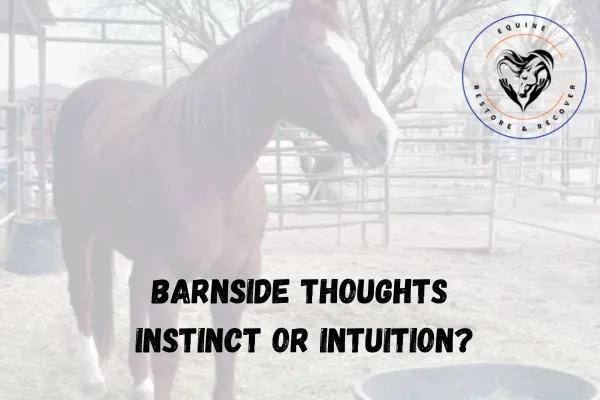
Barnside Thoughts: Instinct or Intuition? Are Some Horses More Intuitive Than Others?

Barnside Thoughts
Instinct or Intuition - And Are Some Horses More Intuitive Than Others?
This morning, while doing barn chores, I watched one of my horses answer that question for me.
Or maybe remind me of something I already knew.
I had just fed everyone their breakfast and was picking up manure when I heard a coyote off in the distance, probably one or two streets over. It wasn’t the chaotic yipping and screaming you hear when there’s a full pack. It was just a single, rapid bark. Sharp. Intentional.
Most of the horses kept their heads down and continued eating without concern.
But Spoon didn’t.
He lifted his head high. His ears locked forward. His entire posture changed.
He spun once, then again, always stopping to face the direction of the sound. Watching. Listening. Assessing.
He tried to eat but couldn’t settle. His nervous system was clearly on alert. This went on for a good 10–15 minutes while the others continued their breakfast, seemingly unconcerned.
Spoon is 18 now. He’s not a particularly spooky horse. He’s lived here for years. He knows his environment.
And yet, in that moment, he assumed the role of sentinel.
He was watching.
Protecting.
Making sure it was safe.
So the question becomes - was this instinct, or intuition?
And are some horses more intuitive than others?
Instinct: The Horse’s Built-In Survival System
Horses are prey animals. Their survival has always depended on their ability to detect danger early, long before it arrives.
This ability is instinctual.
Their nervous systems are designed to constantly scan their environment through sound, smell, and subtle movement. Their ears can pinpoint direction independently. Their sensory awareness is far more refined than ours.
When Spoon heard the coyote, his instinct activated.
His nervous system asked a simple but essential question:
Is this safe?
Until he could answer that question with certainty, he remained vigilant.
This is instinct - hard-wired survival programming designed to protect both the individual and the herd.
Interestingly, not all horses respond equally. In every herd, there are individuals who are naturally more perceptive. Horses who monitor while others relax. Horses who notice first.
These horses often serve as quiet guardians.
Intuition: When Sensory Awareness Meets Emotional Intelligence
But instinct alone doesn’t explain everything.
A few years ago, I experienced something with Spoon that felt like more than instinct.
I had a friend who struggled with alcoholism. During a period when he was sober, he came by the barn one evening while I was feeding. Spoon, who is normally the first to greet anyone, walked over to say hello as usual.
My friend reached out to pet him.
And Spoon walked away.
Not spooked. Not reactive. Just disengaged.
Later, I learned my friend had relapsed and was intoxicated.
Somehow, Spoon knew.
Horses possess an extraordinary ability to detect subtle changes in humans, changes in posture, muscle tension, breathing, and even scent. Alcohol alters the nervous system. It changes coordination, muscle tone, and smell through the skin and breath.
To a horse, whose survival depends on detecting instability, these changes matter.
They rely on coherence. Predictability. Regulation.
When those things are absent, horses notice.
What we often call intuition may actually be the horse’s remarkable ability to read the nervous system of another living being.
Not through thought—but through feeling.
Instinct and Intuition Are Closely Connected
Instinct is the foundation. It is the horse’s built-in survival system.
Intuition is what emerges when that system becomes highly refined through experience, sensitivity, and awareness.
Sensitive horses like Spoon live with their nervous systems tuned more closely to their environment. They notice subtle shifts others ignore.
This doesn’t make them anxious.
It makes them aware.
It makes them perceptive.
It makes them exceptional partners.
As a cutting horse, Spoon spent years reading the subtle intention of a cow before it moved. That same nervous system that made him great in the arena is the one that allows him to detect the world so deeply now.
What Horses Can Teach Us
Horses live in a state of presence.
They do not dwell on the past or anticipate the future. They exist in the now, constantly assessing safety and responding accordingly.
When the coyote barked, Spoon listened.
When he determined there was no immediate threat, he returned to eating.
His nervous system reset.
No lingering anxiety. No rumination.
Just awareness—and then peace.
There is something profoundly grounding about that.
Perhaps what we call intuition in horses is simply their willingness to listen fully—to their environment, to others, and to themselves.
And perhaps there is something we can learn from that.
As always, Spoon continues to teach me more than I ever expected. This reflection has opened the door to an even deeper topic—the science behind emotional therapy horses. More on that in Part 2.

