Learning Acupressure Part 2: Assessments, Meridians, and Meaningful Releases
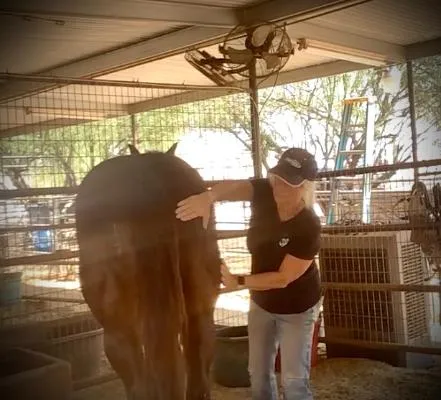
As I mentioned in Part 1, I’ve started exploring equine acupressure as a gentle, hands-on way to support my horses' health—and Rosie has already shown me how powerful it can be.
In the second online course I took, things got deeper. This program introduced more of the history and foundation of Traditional Chinese Medicine (TCM)—including how acupressure and acupuncture evolved as part of a system that’s been used for thousands of years to support energy flow, balance, and healing.
One of the most helpful things I learned in this course was a technique for assessing along the spine. By gently palpating specific points along the back, you can identify areas of sensitivity that help guide which meridian points to focus on during a session. It’s like getting a map of your horse’s body that tells you where they need the most support.
They also introduced a slightly different technique—a more direct style of pressure using the fingertips, compared to the broader hand contact I had used before. It gave me more confidence to be intentional and precise, especially now that I know there are so many points to work with. (Seriously, I had no idea how many!)
I also purchased the course’s companion app, and I’m so glad I did. It’s a great tool for learning and referencing points. It lists:
Meridians
Common conditions and point classifications
Each point’s location, function, and energetics
The only improvement I’d suggest? It could use more layman-friendly descriptions. As a nurse, I’m comfortable with anatomical terms like “caudal” and “posterior,” but folks without a medical background might struggle with some of the wording.
Still, the course itself was well-paced, easy to follow, and clearly presented. They plan to offer more advanced training in the future, but honestly, between the two programs I’ve taken—I have plenty to work on for now.
Practice Makes Progress (and Rosie is My Teacher)
I’ve been continuing to practice on both of my horses, and I’m slowly getting more confident with finding and holding the points. Rosie continues to give me feedback in the best way she can—through body language and subtle (and sometimes not-so-subtle) releases.
In fact, I was lucky enough to catch her on video letting out three big yawns after an acupressure session. I missed the first one while scrambling for my phone, but I’m still thrilled I caught the rest. I’ll include that video here in the blog—because sometimes the best proof is seeing a horse in full release mode for yourself.
If you’re curious about getting started with acupressure, I still have a free PDF that introduces 3 basic points anyone can try. Just message me and I'll be happy to get it to you.
Thanks for reading and following along on this hands-on journey. I have a lot more to learn—but I already know this is another tool I’ll be using to support Rosie and the rest of my herd for years to come.

