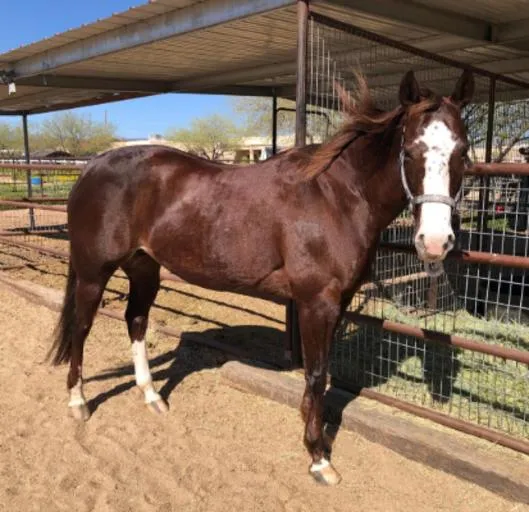
Rosie’s Journey: A Mare’s First Battle with Laminitis

Rosie’s Story and Her Battle to Survive IR/EMS
Part 1: The Mare Who Changed Everything
Her name is Rosie.
On paper, she’s Rosie Rey Badger 008—a striking chestnut mare with softness in her eyes and grit in the pen. I bought her in March of 2020, she was 12. I bought her on a Friday, showed her that weekend and came home as reserve circuit champions in the $15,000 amateur cutting class. From the moment I swung a leg over her, I knew she was something special.
She’s one of the smoothest horses I’ve ever ridden and reads a cow like it’s second nature. Rosie was everything I was looking for: talented, kind, and an absolute joy to partner with in the cutting arena.
I’d only had her a few months when something changed.
It started subtly: a little bit off, and nothing that screamed “emergency.” But "little bit" became "a little bit more" pretty quick.
I’ve had horses for over 30 years, but nothing prepares you for that moment when your gut tells you, something is wrong.
Laminitis? That hadn’t even crossed my mind. It always felt like something distant—something that happened to ponies on spring pasture or horses I’d read about, not mine. Not Rosie.
But when you hear that diagnosis: laminitis, I felt like I was sucker punched.
I was overwhelmed—heartbroken, confused, and full of questions.
How had I missed the signs? What did this mean for her future? For our future?
That moment marked the start of a long journey I never imagined we’d walk—but one that taught me more than I ever expected about equine care, resilience, and the depth of connection between horse and human.
September 2020: Our First Challenge
Rosie became lame, and she was diagnosed with laminitis. Thankfully, it was caught early, and radiographs showed little to no rotation. At the time, our vet believed it was heat-related (we live in Phoenix, AZ), so no bloodwork was done. The treatment would have been the same regardless of the results.
We immediately began treatment:
> Icing her hooves 4 times a day> Bute twice a day > Cloud boots for support > Nutritional/Caloric restriction, which felt harsh but necessary > Soaking her hay> Stall rest with deep bedding
Eventually, Freedom shoes were applied for support. Once she was sound enough, we did lots of hand walking and had lots of conversations and praying.
Our vet did advise we draw labs in the spring to rule out insulin resistance (IR).
Spring 2021: A Glimmer of Hope
When we tested her insulin levels in spring, everything came back normal. It was a relief, and I hoped this had just been a one-time scare.
But Rosie’s story wasn’t over.
In a pattern that still feels like a mystery, she began to have laminitic episodes every other year. And in 2022, she was officially diagnosed with insulin resistance and equine metabolic syndrome (EMS).
Living It, Not Just Learning It
I’ve owned horses for over 30 years, and Rosie is my first to ever battle laminitis, Insulin Resistance or EMS. Living through it—not just reading about it—has changed everything. I’ve felt overwhelmed, confused, emotional, and even helpless at times. But my commitment to Rosie has never wavered.
And her story isn't over yet. In fact, we're still in the middle of it—managing an on again off again flare that began in May 2024. But for now, I wanted to begin sharing this part of our journey—because if you’ve ever loved a horse through chronic illness, you know how important it is to feel seen, informed, and not alone.
Coming in Part 2:
The diagnosis I never expected and the start of a journey that would test us both. I’ll share how hearing the word laminitis for the first time shook me, how we made it through those difficult early days and how Rosie and I began building a bond rooted in trust, prayer, and quiet hope.

