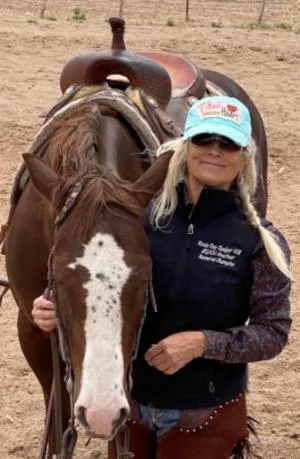
Rosie's Story Part 2
Rosie's Story Part 2
What I Didn't Know, I didn't Know: Learning to Care For an EMS Horse
After the shock of Rosie’s laminitis diagnosis in September 2020, I jumped into action with my vet’s guidance. Thankfully, we caught it early—there was little, if any, rotation—and for that, I’ll always be grateful.
At the time, the cause wasn’t entirely clear. Because we live in Phoenix, AZ, my vet suspected it might be heat-related stress rather than a metabolic trigger, and no labs were drawn. So we focused on treating the immediate crisis:
Iced her hooves four times a day (or as much as possible)
Bute twice a day for inflammation and pain
A sharp caloric reduction that, honestly, felt a little extreme
Deep soft bedding
Cloud boots to protect her front hooves
Eventually, Freedom Shoes for added support
And when she was able, lots of hand walking.
We did what we had to do, and Rosie responded. She started to feel better. But the uncertainty stuck with me—was this a one-time event? Was there something we were missing?
My vet suggested we run labs the following spring to check for insulin resistance, just to be safe. In spring 2021, we did. The results came back normal.
I exhaled. Maybe it really was just the heat. Maybe she was in the clear.
But Rosie had a different plan.

The Pattern I Didn’t Expect
She had another laminitic flare in 2022—two years later, again, subtle at first, and again, heartbreaking. This time my regular vet was out of town, so I had to haul her into a local clinic. As fate would have it, the vet on call that day was an equine endocrinologist. X-rays and labs were done immediately, and this time, the results were clear: she was insulin resistant.
We had our diagnosis—equine metabolic syndrome (EMS)—and a name for the fight we were truly in. This vet scared me a little as she impressed upon me the seriousness of this diagnosis.
And that’s when I started learning what I didn’t know I didn’t know. That insulin can fluctuate. That early testing can miss it. That IR doesn’t always present in obvious ways. And that the right care plan isn’t one-size-fits-all—it’s trial, error, and a lot of listening to your horse.
The Learning Curve
Managing Rosie became a full lifestyle shift—for her and for me. We had to rethink everything:
Low-NSC hay, tested and soaked
Supplements designed for metabolic support
Metformin
InsulinWise
Thyro-L
Careful movement plans—not too much, not too little
Ongoing hoof support
No more grains, sweet treats, or stress triggers
Constant vigilance during weather changes and seasonal shifts
I just kept thinking this vet has to be wrong. I was in denial that this could be happening to my Rosie. And even though I’m a registered nurse and an equine massage and BEMER practitioner, this journey was a reminder that even the most experienced horse people are always learning.
It’s hard to write this without tears—because I remember the fear, the frustration, the guilt of not catching it sooner. But I also remember the love. The fight. The little moments when Rosie let me know she was still in there, still trusting me.
Healing, Bonding, and Hope:
During all of the hand walking I have done through three episodes of laminitis, there was lots of talking out loud, praying, speaking positive thoughts and outcomes, reminding her of what an amazing cow horse she is, and lots of connecting. I just wanted to make the best of this time and such a sad situation (being unable to ride her). These walks became a daily ritual. I told her she would, she had to get through this, and part of it was up to her.
In the next part of her story, I’ll share what started to work—what made a real difference, how we found rhythm again, and what gave me hope when I needed it most.
If you’re in this journey, too—please know: you’re not alone. Your horse is not a diagnosis. And healing, while never linear, is possible.


